Maurice Ravel’s most famous work is Boléro. Written in 1928 for a large orchestra, Boléro was Ravel at the top of his game. It remains an orchestral tour de force and was one of the last works he completed before a crippling illness reduced his capacity to compose music.
Most people have heard Boléro, and many know the drill: two melodies (one major, one minor) each repeated over and over … and over, again, growing in intensity with ever-increasing dynamics and clever orchestration, until the full force of the symphony orchestra finally comes to a crashing halt (thanks to a modulating coda).
Some people can even name the order of the instrumental solos that play in pairs throughout the work. However, much like Lord of the Rings devotees venturing into the Mines of Moria, it gets a little murky the further you go.
You see, Ravel was not only a great composer, he was also an exquisite orchestrator who liked to explore the possibilities of instruments beyond standard orchestral instruments. His writing for piccolo, E flat clarinet, bass clarinet, oboe d’amore, cor anglais, contrabassoon and saxophone displayed a great understanding of each instrument’s capabilities.
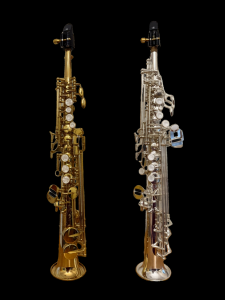
His writing for saxophone in Boléro, however, has left us with a perplexing riddle that continues to this day. A riddle wrapped in an enigma that involves the smallest of saxophones, the sopranino saxophone, which I like to call ‘The Little Devil’.
In Boléro, the saxophones pick up the minor melody after the muted trumpet/flute solo. From the original orchestral score, we can see that Ravel wrote these two solos for three saxophones played by two players.
The first solo on the tenor saxophone has remained the same since the work was first performed at the Paris Opéra on 22 November 1928. It is the second saxophone solo that has caused confusion, and where Ravel’s efforts to write within the comfortable range of auxiliary orchestral instruments may have led to his undoing.
The second saxophone solo features a sopranino (‘The Little Devil’) saxophone for the first part of the solo until it gets too low, at which point the tenor saxophonist seamlessly takes over on soprano saxophone … An inspired piece of orchestration?
Maybe. But Ravel made one small error that has unfortunately banished the tiny sopranino saxophone from one of the greatest orchestral pieces.
To understand this further, we must travel back to the early 1840s and visit the Paris workshop of Adolph Sax, the Belgian instrument maker and inventor of the saxophone. It seems that when Ravel came to scoring Boléro and wanted a high-pitched saxophone for the second solo, he must have come across a copy of Sax’s original patent for all the saxophones he intended to produce and chose the sopranino in F. The trouble is, it didn’t exist – Sax never got around to making one.
It wasn’t until rehearsals for Boléro’s 1928 premiere were well underway that the mistake was noticed. A substitution was hastily made, and the solo was played entirely on a soprano saxophone. The tiny sopranino saxophone never had its moment of glory.
The story does not end there. Incredibly, even though the score was published a year after the premiere, it remains the same to this day and the solo part for sopranino saxophone in F is still included. And it transposes perfectly to the modern-day E flat sopranino!
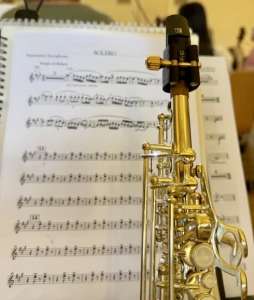
And you, dear audience, will have the great pleasure of hearing that very sopranino saxophone solo if you come along to the IWSO’s performance of Boléro on Sunday 26 April at 2 pm at Williamstown Town Hall.
It will be a rare treat to hear Boléro played just as Ravel intended, and a big westside comeback for ‘The Little Devil’!
By Andrew Derrett